GPS running watches: what actually changes accuracy
Updated on August 13, 2026
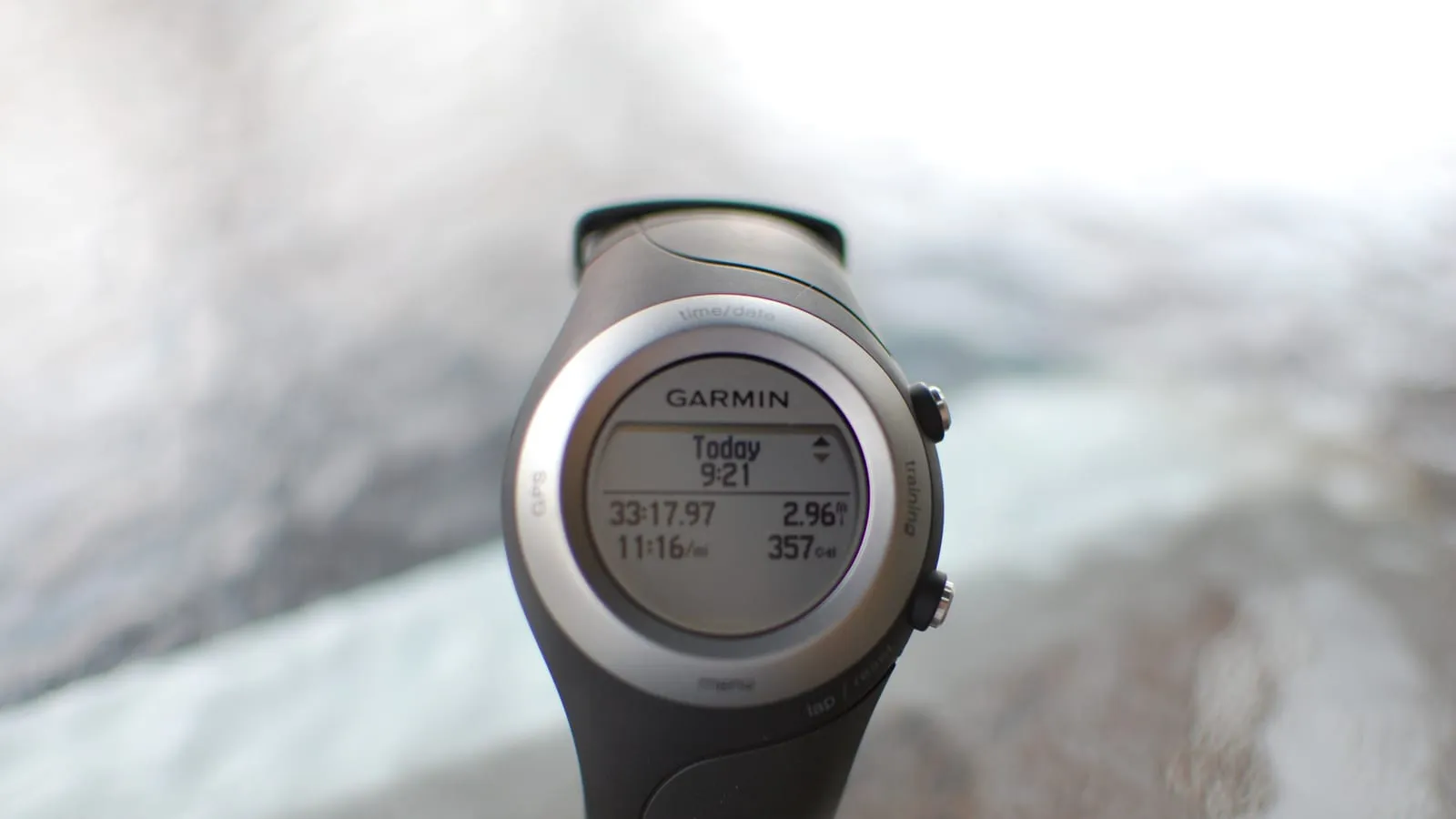
Most people who start running with a watch notice two things in the first week: the track on the map cuts through the middle of a block, and instant pace jumps from 8:00 to 9:45 without their legs doing anything different. Neither one is a defect. Both come from the same place, which is how GPS works on a wrist, and understanding it changes what you should be shopping for.
Built-in GPS or borrowed from your phone
This is the first split, and it matters more than any spec on the box.
A watch with built-in GPS has its own antenna and records the route by itself. A watch with connected GPS has no antenna at all: it asks your phone for the position over bluetooth. That works fine, but only while the phone is with you.
If the plan is to leave the house with a key and nothing else, it has to be built-in. If you carry your phone anyway, for music or safety, connected GPS saves money and battery. Worth checking, because plenty of cheap bands advertise “with GPS” and mean the connected kind. In that setup what actually shapes the run is the pair of sports earbuds, not the watch antenna.
Why the track drifts near buildings
The watch works out where you are from how long the signal takes to arrive from each satellite. On a street with tall buildings on both sides, some of that signal does not arrive directly: it bounces off a wall and shows up slightly late. The watch reads late as far away, and the point lands in the wrong place. That is why your track clips corners, jumps to the other side of the street, or zigzags through a stretch you ran in a straight line.
Two things attack this:
- More constellations. Besides American GPS there is Galileo (Europe), GLONASS (Russia) and BeiDou (China). A watch listening to several has more satellites in view and suffers less when some are blocked. It is close to standard now, but often switched off in battery-saver mode.
- Dual frequency. The watch listens to the same satellite on two frequencies at once and compares the readings. A reflected signal arrives differently on each, so it can be spotted and thrown out. It is the biggest accuracy jump available today, and the reason to pay more if you run in a city.
Accuracy is paid for in battery
The “14 days of battery” on the box assumes GPS is off and the watch is being a watch. With continuous GPS, the same device usually talks in tens of hours, not days. Turning on every constellation plus dual frequency pushes that number down further.
In practice it only bites in two cases: a long race, and a high-volume week away from a charger. For an hour-long run, any of the three here gets through the week comfortably.
Instant pace lies, and it is not your fault
Instant pace comes from a simple sum: how far you moved in the last few seconds, divided by the time. Since your position carries a few meters of error either way, that error goes straight into the sum. Two or three meters of noise over a short interval turns into tens of seconds per mile on the screen.
That is why experienced runners do not watch instant pace: they watch lap average pace, which is calculated over a distance long enough for the error to wash out. If your watch lets you choose what shows on the main screen, change it, and half your anxiety disappears.
What each one gets criticised for
Nobody picks a running watch off a spec sheet: runners pick the one that survives a training week. In long-term owner reports, each of these three has a clearly defined weak spot, and it is a different one in each case.
With the Amazfit Bip 6, the weak spot is the antenna. Without dual frequency, satellite lock takes longer and can fail outright in enclosed spaces, something Amazfit’s own support documentation acknowledges. Runners comparing it against dedicated sports watches call the GPS good enough rather than accurate, with a longer wait before the signal settles. On open roads that barely registers. Starting a run mid-block between tall buildings, it does.
With the Coros Pace 3, the track is the strong point, so criticism moves to the optical heart rate sensor: independent testing puts it behind Garmin and Polar under some effort conditions, mostly when intensity changes quickly. That does not undo the case for the watch, it just restates the general rule of running watches, which is that a chest strap fixes more on interval day than a new watch does. The transflective screen splits opinion for the same reason it exists: brilliant in sunlight, flat indoors.
With the Forerunner 165, software and battery collect the praise, and the complaint that repeats most among owners several months in is inconsistent wrist heart rate. Add the single-band GPS and the pattern in this price bracket is clear: you buy either the better track or the better guided training, rarely both.
Prices swing a lot between sales and versions, and the Music edition usually costs noticeably more. Check the current price before buying.
Quick comparison
| Model | Best for | Price range |
|---|---|---|
| Amazfit Bip 6 | A first watch with real built-in GPS | $80 – $110 |
| Coros Pace 3 | Track accuracy on city runs | $200 – $250 |
| Garmin Forerunner 165 | Guided training and the ecosystem | $230 – $300 |
If this is your first watch and you want to run without your phone, the Amazfit solves it for a fraction of what the other two cost. If you run between buildings and the crooked track bothers you, dual frequency is what you are buying in the Coros, and nothing cheaper does it. And if what you are missing is not data but a plan, the Garmin is the only one here that builds the training for you.
Our recommendations
Coros Pace 3
The cheapest way to get dual-frequency GPS, which makes it the pick for city running.
Pros
- Dual-frequency GPS cuts the track errors you get near tall buildings and under tree cover
- Very light, you stop noticing it on long runs
- Battery with GPS running lasts through a full marathon with room to spare
Cons
- Transflective screen wins in sunlight but looks dim indoors
- Plastic build makes it clearly a training watch, not an everyday one
- Independent wrist heart rate testing puts it behind Garmin and Polar in some effort conditions, which is the argument for a chest strap on interval days
- A newer generation exists, so check whether the discount is real
$200 – $250
Check price on AmazonGarmin Forerunner 165
For runners who want a plan, not just numbers: Garmin Coach is what you are paying for.
Pros
- Garmin Coach builds and adjusts a training plan on its own, which nothing else does at this price
- AMOLED screen, much easier to read indoors and at night
- Mature ecosystem, syncs cleanly with Strava and everything else
Cons
- Single-band GPS here, so it loses to the Coros on track accuracy
- Battery with GPS on runs down noticeably faster
- Inconsistent wrist heart rate is the complaint that repeats most among owners several months in, even where battery and software get praised
- The Music version costs more and is easy to buy by mistake
$230 – $300
Check price on AmazonAmazfit Bip 6
The cheapest way to get real built-in GPS and leave the phone at home.
Pros
- Built-in GPS, so it records the run without your phone
- Multi-day battery in normal use, charging stops being a routine
- Big, bright screen that is easy to read mid-run
Cons
- Single-band antenna, so it drifts more between tall buildings, and Amazfit's own support notes that satellite lock can be slow or fail in enclosed areas without dual frequency
- Wrist heart rate lags during intervals, and side-by-side comparisons describe the GPS as fine but not the most accurate, with a longer wait for lock than rivals
- Training features are far simpler than a sports brand's
$80 – $110
Check price on AmazonPrices are reference ranges and change often, so check the current price on Amazon before buying.
Frequently asked questions
Why did my watch record 26.4 miles in a 26.2 mile marathon?
Because the two numbers measure different things. The official course is measured along the shortest legal line, hugging every corner. You run wide, dodge people, cross the road for shade, and that adds up over 26 miles. Add normal GPS error on top and a few hundred extra meters is expected, not a broken watch.
Is dual-frequency GPS worth it or just marketing?
It depends where you run. It exists to deal with signal reflection, meaning the satellite signal bouncing off a building before it reaches your wrist. If you train on avenues with towers on both sides or under heavy tree canopy, you will see the difference in the track. On an open park loop or a track, single band gets you almost the same result and uses less battery.
Do I still need a chest strap if the watch reads heart rate at the wrist?
For steady runs, no. For intervals, yes, and the gap is big. The wrist sensor reads light changes through your skin and takes several seconds to catch up with a sharp change in effort, so it lags exactly during short repeats, which is where the number matters. A strap reads the heart's electrical signal and tracks it immediately.